Discovery of large horseshoe crab footprint fossils from 240 million years ago = Anhui Province, China


Enlarge
A joint research team of Chinese and international paleontologists recently discovered trace fossils of large horseshoe crabs from over 240 million years ago in a stratum in Anhui Province.
(1 / 2 images)
A joint research team of Chinese and international paleontologists recently discovered trace fossils of large horseshoe crabs from over 240 million years ago in a stratum in Anhui Province. According to researchers, this is the first time that physical evidence has been found showing large horseshoe crabs were active in the Early Triassic Chaohu Fauna (a fossil group of marine organisms discovered from strata in the Chaohu area of the same province), providing new clues for understanding the marine ecosystem after the mass extinction at the end of the Permian and beginning of the Triassic periods. The research results were recently published in the international academic journal of paleontology "Journal of Paleontology."
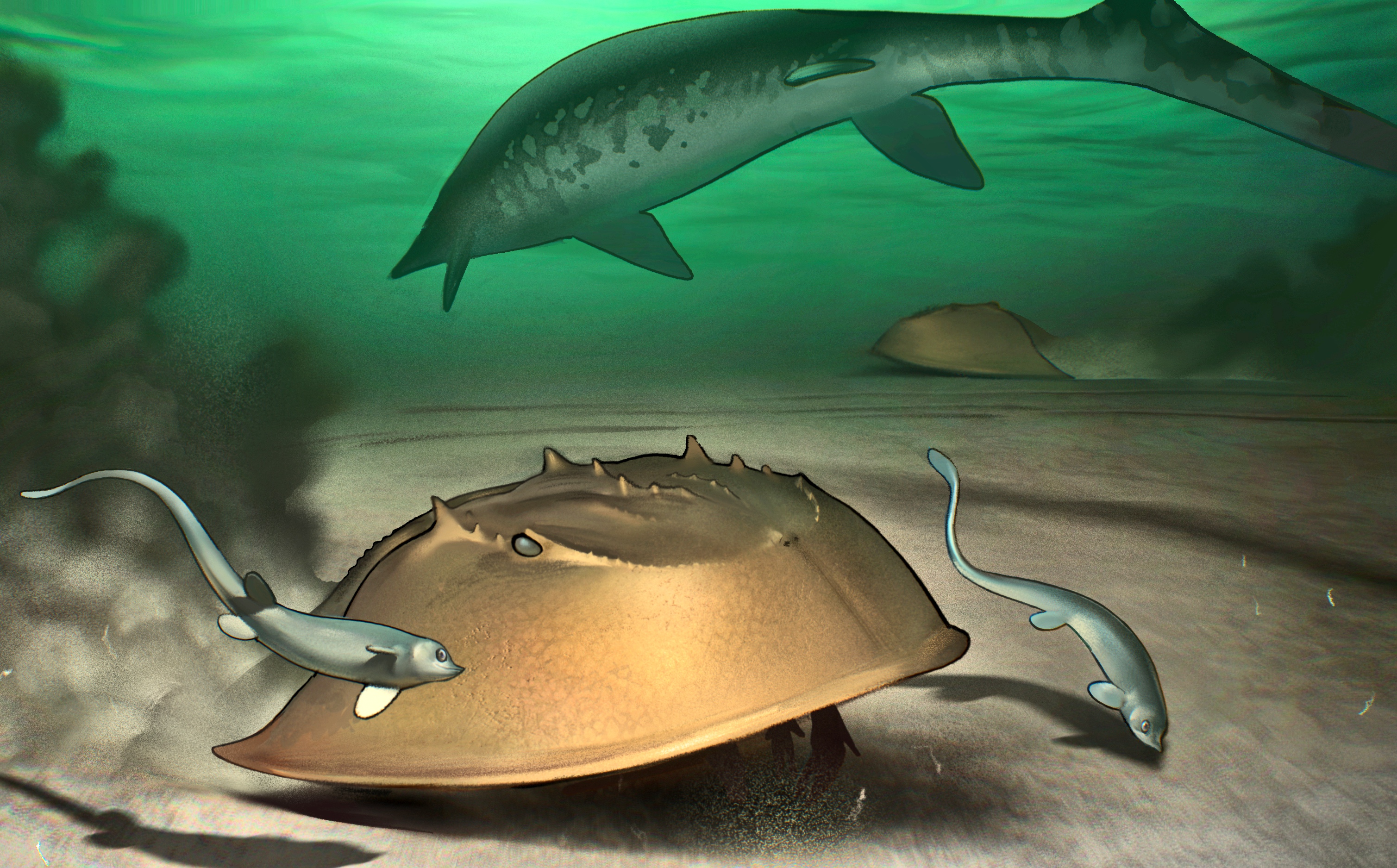
Horseshoe crabs, known as "living fossils" of the animal kingdom, are omnivorous creatures whose body shape resembles a ladle. A joint team of researchers from domestic and international research institutions, including Chaohu University in Anhui Province, China University of Geosciences (Beijing), and the Federal University of São Carlos in Brazil, confirmed 9 complex traces, drawing curves and straight lines, from the strata of the Early Triassic Nanlinghu Formation in the same province. The longest one reaches 5.2 meters. The organisms that left these traces were large horseshoe crabs, with an estimated body width of up to 45 centimeters and a total length exceeding 70 centimeters, with the largest individuals possibly reaching 95 centimeters. This makes them one of the largest species of Triassic horseshoe crabs currently identified. (Source/Xinhua News Agency)
【その他の写真】
Related News