"My daughter, be happy" - A "moving bridal trousseau" commissioned by a Chinese king 2600 years ago for his beloved daughter.


Enlarge
Besides gold, silver, treasures, and luxurious clothing, what kind of "bridal trousseau" did ancient Chinese monarchs prepare for their daughters' weddings?
(1 / 4 images)
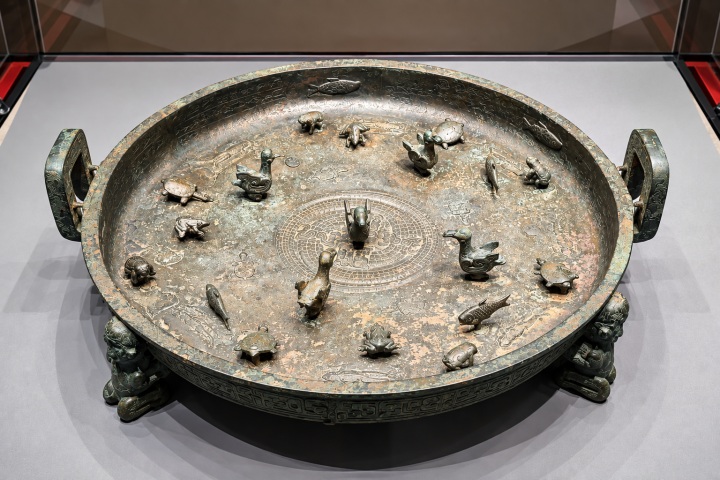
Besides gold, silver, treasures, and luxurious clothing, what kind of "bridal trousseau" did ancient Chinese monarchs prepare for their daughters' weddings? Among them, particularly special is the bronze vessel "Jingong Pan," said to have been commissioned by Duke Wen of Jin, known as one of the "Five Hegemons of the Spring and Autumn Period," for his beloved daughter.
【その他の写真】
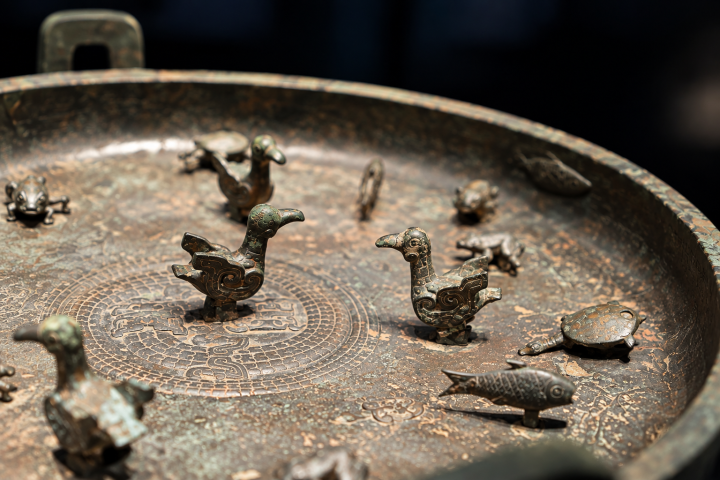
This bronze vessel, created approximately 2600 years ago, is not merely a ritualistic tool. Various animals such as birds, turtles, fish, and frogs are arranged within the basin, and surprisingly, each is equipped with a mechanism that allows it to rotate 360 degrees. It is an astonishing bronze vessel, like an ancient "moving toy."
The "Jingong Pan," housed at the Shanxi Museum, has a diameter of approximately 40 centimeters and weighs over 7000 grams. It is used in combination with a bronze basin (pan) and an "Yi" (ewer), where water is poured from the Yi and received in the pan to wash hands.
During the Yin and Zhou Dynasties, bronze vessels symbolized the status of royalty and nobility. Therefore, common bronze vessels often have a cold and solemn impression. However, this "Jingong Pan" is a little different.
On the inside of the basin, two exquisitely carved dragons are arranged in a circular pattern in the center. Furthermore, all 19 animals attached to the basin are designed to rotate 360 degrees. When water flows in, the animals, which were still, begin to move as if "brought to life."
Waterfowl open and close their beaks, and soft-shelled turtles extend and retract their heads. Fish swimming in the water appear and disappear, and frogs play. Nearby, small birds seem to chirp, creating a lively scene. It is as if Duke Wen's childhood memories of playing with his beloved daughter by the pond are preserved directly within the bronze vessel.
So, how exactly did artisans from 2600 years ago create such an intricate mechanism? The mystery was unraveled by X-ray CT (computed tomography) technology.
According to investigations, the "Jingong Pan" was created using an advanced casting technique called "segmental casting." The main body of the basin, the handles, the three human-shaped legs, and the animal parts were each cast separately and then assembled. Among these, the moving animals within the basin required particularly advanced techniques.
Inside each animal, a "pillar" is provided. First, the pillar is made, its upper part is wrapped with an earthen core, and molten copper is poured into the outer mold. It is believed that this complex structure allowed the animal parts to be fixed while still being able to rotate freely by 360 degrees. Artisans from 2600 years ago had achieved a mechanism as sophisticated as modern children's toys.
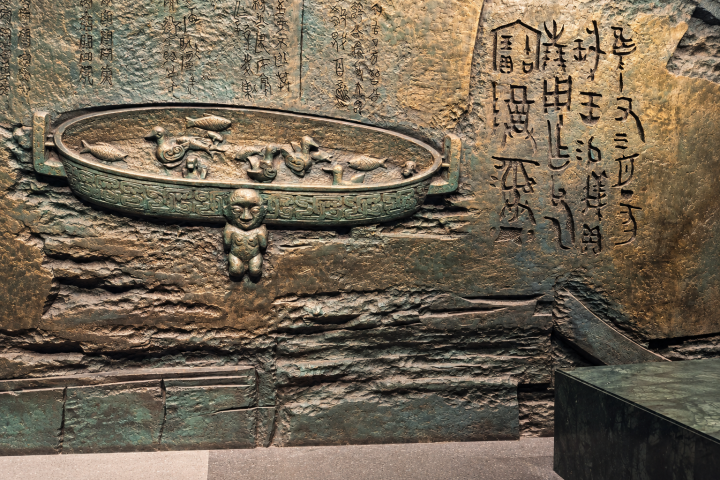
What makes the "Jingong Pan" remarkable is not just these "moving mechanisms." A total of 183 characters are inscribed on the inner wall of the basin across seven locations.
Firstly, it records the achievements of Tang Shuyu, the ancestor of the Jin state, who assisted King Wu of Zhou and pacified the world. Next, it narrates the deeds of Duke Wen's father, Duke Xian, who expanded the territory, and further shows Duke Wen's own determination to inherit the previous generation's undertakings. Finally, his beloved daughter, "Meng Ji," appears.
Duke Wen inscribed that he created this basin for his daughter, wishing her a happy life even after she married. In other words, the 183-character inscription can be said to contain two sentiments.
"My Jin state is this large and powerful. It cannot be easily underestimated." And the other is a father's wish: "My daughter, I want you to live happily and healthily forever."
The "Jingong Pan" is a valuable cultural asset that conveys the advanced casting technology and powerful national strength that the Jin state boasted 2600 years ago. At the same time, what emerges from it is not just Duke Wen as a powerful ruler. The image of a father who commissioned an exquisite "custom-made item" for his daughter and wished for her happiness after marriage also appears.
Ancient bronze vessels often have a cold and solemn image. Yet, within this one are embedded warm memories between a parent and child, and "the heart of a father wishing for his daughter's happiness." Perhaps this is why the "Jingong Pan" continues to fascinate people across 2600 years. (Translation and Editing / Teruya Kobayashi)
Related News